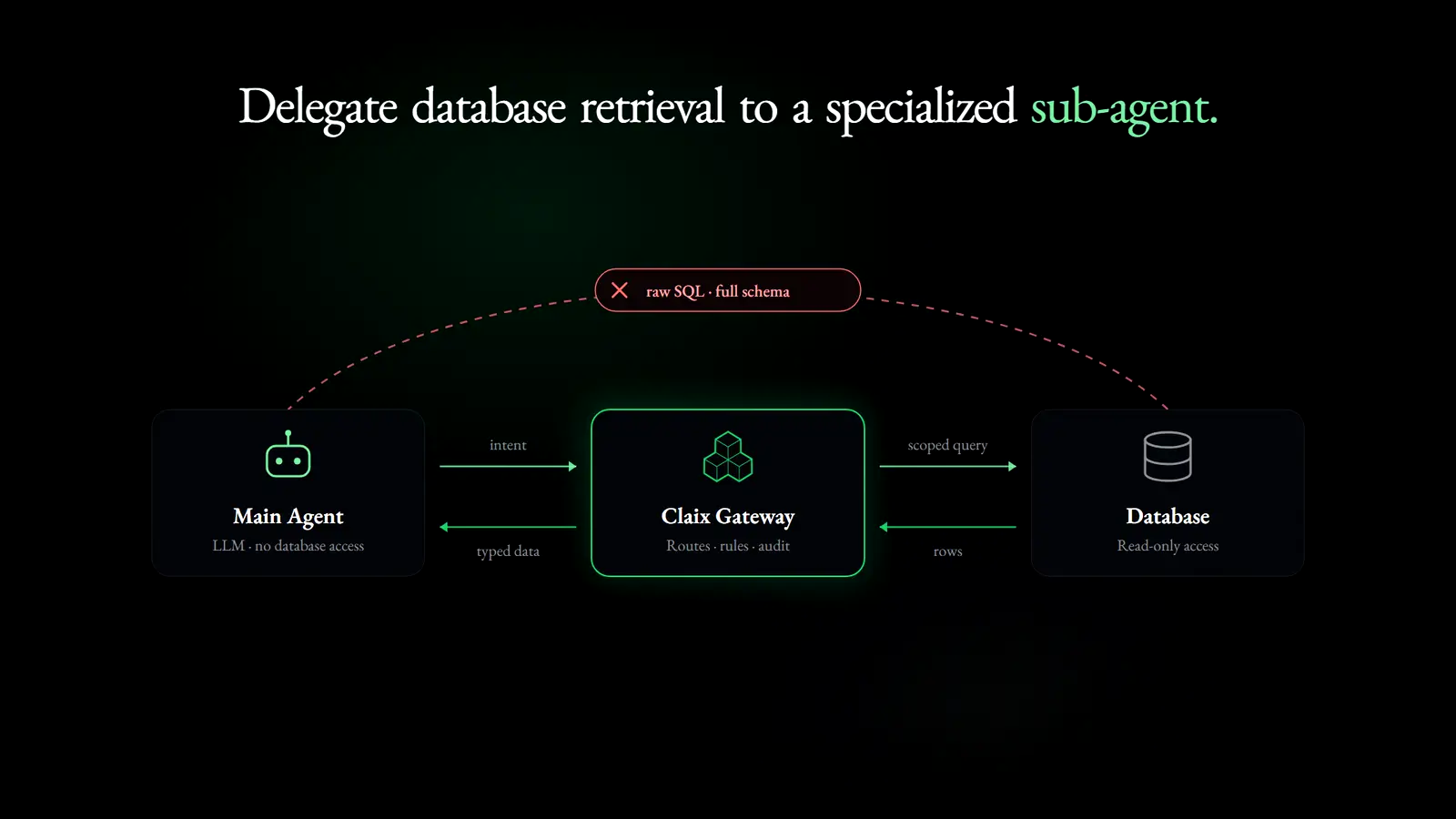
Claix is the controlled data retrieval layer for AI agents: it connects to your relational database and lets each agent retrieve only the tables and columns you allow, guided by your own rules and returned as validated results or typed answers, without moving your data. Available via REST API, MCP, and A2A.
From database to working agent. In minutes.
1
Connect your database
Link your Postgres database with a read-only role. Claix reads its structure and drafts a Data Map (tables, descriptions, and relationships) for you to review and edit.
Postgres · MySQL
2
Define the rules and retrieval
This is where you set everything up, in two parts:
Create routes.
A route is a retrieval capability: you pick the tables and columns it can use and write a short guide with your rules and vocabulary.
Create your agent.
Give it a name and a description, write its business prompt (what it does and when to use each route), attach its routes, and choose how it answers: raw results or reasoned, typed answers.
No YAML, no frameworks, no code.
3
Let your agent fly
Call one endpoint and your agent gets everything it was missing:
Answers from your live data, not from a stale copy or from the model’s memory.
Typed values it can use directly. Booleans, numbers, lists, and objects: no parsing text, no regex.
Many questions in one request, answered in order, so fewer round trips.
A lighter context. The agent doesn’t need your schema in its prompt or any SQL knowledge: it just asks.
A clear boundary. It can only answer from the tables and columns you allowed.
Plug-in compatibility. Works with the agent framework and the model you already use.
Everything your agent needs. Under your control.
Routes and agents
Routes and agents: retrieval you define once
A route says what can be retrieved: the tables and columns allowed and a guide with your rules. An agent is the identity that uses them: its own endpoint, its own business prompt, and its own routes. Create a route once and attach it to as many agents as you need. A support bot and an internal assistant can share the same database and still see different data.
Agent
restaurant-ops
Route
floor-ops
restaurants · reservations
Route
staffing
employees · shifts
Access controlled
Access fully controlled and supervised by you
Delegate data access to your agents without handing over your database. Claix connects with a read-only role, and agents only reach the tables and columns you include in a route. Everything outside that perimeter doesn’t exist for them. Queries are validated before they run, and every request is traced so you can review what was asked, which route answered, and what came back.
Read-only by design.
Only what you allow, per route and per agent.
Validated before it runs.
Every query traced, reviewable at any time.
MCP, A2A, REST
Integrations: MCP, A2A, and REST
Every agent you create gets its own endpoint. Call it over REST, expose it as an MCP server so any MCP-compatible client can use it as a tool, or connect it over A2A so other agents can delegate data questions to it. Use it from Claude, Cursor, your own agent framework, or any tool that can send an HTTP request, such as n8n.
curl -X POST "https://claix.dev/retrieve/restaurant-ops" \
  -H "x-api-key: <YOUR_API_KEY>" \
  -H "Content-Type: application/json" \
  -d '{"questions":[{"question":"How many tables are reserved this Saturday between 20:00 and 22:00?","format":"int"}]}'
BYOK
Bring your own LLM key and cut the cost
Use Claix Managed AI and we handle the model, the setup, and the updates. Or connect your own key from OpenAI, Google, Anthropic, or xAI and choose your model. With your own key, the Claix fee drops from €0.10 to €0.02 per question, and you pay your provider’s tokens directly.
With your own key, results depend on the model you choose. Test it in the Sandbox before going live.
Claix is the controlled data retrieval layer for AI agents: it connects to your relational database and lets each agent retrieve only the tables and columns you allow, guided by your own rules and returned as validated results or typed answers, without moving your data. Available via REST API, MCP, and A2A.
How do I get started?
In three steps: connect your Postgres database with a read-only role (Claix drafts a Data Map for you to review), define routes and agents with your rules (no YAML or code), then call one endpoint so your agent gets live typed answers inside the perimeter you set.
Does Claix copy my data into a vector store?
No. Claix does not copy your data or build a vector index over it. Agents query your database where it lives, within the tables and columns you allow. Every query is validated before it runs and traced afterward.
Does Claix write to my database?
No. Claix connects with a read-only role. Loading documents into structured fields is a separate product, Claix Ingest, which you choose to use.
Which databases does Claix support?
Postgres today (including Postgres-compatible setups such as Supabase). You connect with a read-only role so agents never get write access through Claix.
What are routes and agents?
A route is a retrieval capability: the tables and columns allowed plus a short guide with your rules and vocabulary. An agent is the identity that uses them—its own endpoint, business prompt, attached routes, and response mode (raw results or reasoned typed answers). Create a route once and attach it to as many agents as you need.
How do I call a Retrieve agent?
POST to /retrieve/{agent_name} with a JSON body of questions (each with an optional format such as string, int, boolean, json, or array:string). You get typed answers in order plus a log_id. The same agent is also reachable over MCP (claix.retrieve.ask) and A2A.
What answer formats can I request?
In reasoned mode you can ask for string, int, boolean, timestamp, timestamptz, date, json, array:string, or array:int. Typed values mean your workflow can branch on booleans, use numbers and lists directly, and skip parsing free text.
How does pricing work?
With Claix Managed AI the fee is €0.10 per question. With your own LLM key (BYOK) from OpenAI, Google, Anthropic, or xAI, the Claix fee drops to €0.02 per question and you pay your provider’s tokens directly. Results with your own key depend on the model you choose—test in the Sandbox before going live.
Is agentic RAG the same as vector RAG?
No. They sit on different axes. “Agentic” is about who triggers retrieval (a fixed pipeline vs an agent calling a tool). “Vector” is about how results are matched (embeddings). An agent can call SQL, BM25, or embeddings; a fixed pipeline can use hybrid search. For relational business data, embeddings are often the wrong default.
Is SQL retrieval RAG?
Yes. RAG means retrieved information feeds the model. It does not require embeddings, and the retrieved information does not have to be text chunks. A SQL query that returns live records for the model is still retrieval.
When should I still use a vector database?
When you need semantic discovery over a large permanent text collection, heavy repeated search traffic, or a product where search is the product. For exact values, counts, dates, and live rows already in Postgres, query the database where it lives with scoped access instead of copying it into an index.
Can I use Claix from LangChain, Cursor, or n8n?
Yes. Claix is not an agent framework—it is a retrieval layer you call from the stack you already use. Call REST from any HTTP client (including n8n), expose the agent as an MCP tool for Cursor and compatible clients, or connect over A2A so other agents can delegate data questions.
What happens when the answer is not in the allowed tables?
The field comes back empty instead of a guess. Queries only run inside the routes you attached to the agent; everything outside that perimeter does not exist for them. Traces show what was asked, which route answered, and what came back.
How is Claix different from giving an agent a database MCP server?
A generic database MCP connection is quick to wire up, but the access model depends on the server and the role you attach. Claix adds routes, per-agent allowlists, validation before queries run, typed multi-question answers, and a reviewable trace—so you define the boundary once and enforce it on every call.